A LCA measures environmental impact of products or services over their life cycle.
A LCA analyses all the inputs (i.e. raw materials, water, and energy) and outputs (i.e. the end product, waste, emissions) from manufacturing a product and its transportation and use in construction, maintenance and disposal.
Improving the design and operational energy of a house is the best way to significantly reduce greenhouse gas emissions
The walling material(s) make very little impact on the total greenhouse gas emissions caused by house
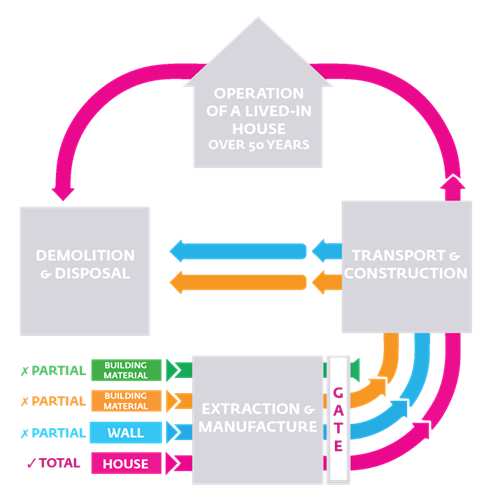
Comparing building material requires measuring the four stages of a building total life cycle:
Australia’s building sector is responsible for almost 23% of Australia's greenhouse gas emissions (ASBEC).
An average Australian house’s embodied energy emissions i.e. those only from producing a building including mining natural resources, material transport and product delivery but not disposing of a building represents only 11% of the total emissions over a 50-year life cycle, regardless of walling materials.
Most emissions from houses come from operational energy we use to live in our homes (e.g. heating, cooling, lighting, TVs etc.).
An LCA can measure operational and embodied emissions for a complete picture into the energy efficiency and environmental impacts of buildings.
LCAs can differ in what they actually measure, even if they follow the ISO 14040 Standard. An accurate total LCA will take into account both the embodied and operational energy of a building material.
The International Standards Organisation (ISO) sets world-wide standard for many testing methods, including LCAs.
Some LCAs do not use these ISO standards. All published LCAs that compare standards must follow these requirements.
Think Brick Australia’s total LCA complied with international standards and best international practices. It was also peer reviewed to measure the total environmental impact of bricks and brick buildings.
There are 4 different types of LCAs. ISO Standard 14040 states that they are all accurate. When comparing building materials, it is essential similar LCAs are used:
Most building material LCAs measure environmental impacts from the “cradle to gate” only measuring the environmental impact of building materials during the products extraction and manufacture only.
Other LCAs measure more, from the “cradle to grave” for either a single unit of building material or a section of that material assembled in a building (e.g. a square metre of wall) for a more complete analysis
LCA cradle to gate and cradle to grave assessments don’t consider the direct effect of operational emissions from living in a building mainly from heating and cooling.
A Total LCA can measure the environmental impact of building materials from the cradle to grave and measure the effect operational emissions from living in a building have on building materials for the environment. Operational emissions can contribute nearly 90% of total emission from a building so it’s vital to include these emissions in an environmental impact analysis
Check out:
Think Brick Australia Sustainability and Energy Efficiency.